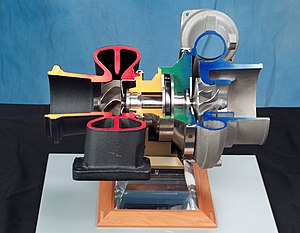
Showing posts with label Turbocharger. Show all posts

Thursday, 30 January 2014

Variable Turbochargers Geometry (VTG)

Variable geometry turbochargers (VGTs) are a family of turbochargers, usually designed to allow the effective aspect ratio (sometimes called A/R Ratio) of the turbo to be altered as conditions change. This is done because optimum aspect ratio at low engine speeds is very different from that at high engine speeds. If the aspect ratio is too large, the turbo will fail to create boost at low speeds; if the aspect ratio is too small, the turbo will choke the engine at high speeds, leading to high exhaust manifold pressures, high pumping losses, and ultimately lower power output. By altering the geometry of the turbine housing as the engine accelerates, the turbo’s aspect ratio can be maintained at its optimum. Because of this, VGTs have a minimal amount of lag, have a low boost threshold, and are very efficient at higher engine speeds. VGTs do not require a waste gate.

01-variable turbine geometry-turbocharger-vtg-sequence

Most common designs
The two most common implementations include a ring of aerodynamically-shaped vanes in the turbine housing at the turbine inlet. Generally for light duty engines (passenger cars, race cars, and light commercial vehicles) the vanes rotate in unison to vary the gas swirl angle and the cross sectional area. Generally for heavy duty engines the vanes do not rotate, but instead the axial width of the inlet is selectively blocked by an axially sliding wall (either the vanes are selectively covered by a moving slotted shroud, or the vanes selectively move vs a stationary slotted shroud). Either way the area between the tips of the vanes changes, leading to a variable aspect ratio.

01-normal_turbo charger-vtg turbo-turbine section-compressor section

Actuation
Often the vanes are controlled by a membrane actuator identical to that of a waste gate, however increasingly electric servo actuation is used. Hydraulic actuators have also been used in some applications.
01-Twincharger_theory-turbocharger layout diagram
Main suppliers
Several companies supply the rotating vane type of variable geometry turbocharger, including Garrett (Honeywell), Borg Warner and MHI (Mitsubishi Heavy Industries). The rotating vane design is mostly limited to small engines and/or to light duty applications (passenger cars, race cars and light commercial vehicles). The only supplier of the sliding vane type of variable geometry turbocharger is Cummins Turbo Technologies (Holset), who are effectively the sole supplier of variable geometry turbochargers for applications involving large engines and heavy duty use (i.e. trucks and off highway applications).

01-turbo-parts-turbocharger section-compressor air discharge
Other common uses
In trucks, VG turbochargers are also used to control the ratio of exhaust re-circulated back to the engine inlet (they can be controlled to selectively increase the exhaust manifold pressure exceeds the inlet manifold pressure, which promotes exhaust gas recirculation (EGR)). Although excessive engine back pressure is detrimental to overall fuel economy, ensuring a sufficient EGR rate even during transient events (e.g. gear changes) can be sufficient to reduce nitrogen oxide emissions down to that required by emissions legislation (e.g. Euro 5 for Europe and EPA 10 for the USA).
01-turbocharger-Vtg-cross sectional diagram-control system
Another use for the sliding vane type of turbocharger is as downstream engine exhaust brake (non-decompression type), so that an extra exhaust throttle valve isn’t needed. Also the mechanism can be deliberately modified to reduce the turbine efficiency in a predefined position. This mode can be selected to sustain a raised exhaust temperature to promote "light-off" and "regeneration" of a diesel particulate filter (this involves heating the carbon particles stuck in the filter until they oxidize away in a semi-self sustaining reaction – rather like the self-cleaning process some ovens offer). Actuation of a VG turbocharger for EGR flow control or to implement braking or regeneration modes generally requires hydraulic or electric servo actuation.

Turbocharger

01-twin turbo-supercharger and turbo 

A turbocharger is actually a type of supercharger. Originally, the turbocharger was called a "turbo super charger." Obviously, the name was shortened out of convenience.
01-Twincharger_theory-turbocharger layout diagram
A turbocharger’s purpose is to compress the oxygen entering a car’s engine, increasing the amount of oxygen that enters and thereby increasing the power output. Unlike the belt-driven supercharger that is normally thought of when one hears the word "supercharger," the turbocharger is powered by the car’s own exhaust gases. In other words, a turbocharger takes a by-product of the engine that would otherwise be useless, and uses it to increase the car’s horsepower.

01-turbo-parts-turbocharger section-compressor air discharge

Cars without a turbocharger or supercharger are called normally aspirated. Normally aspirated cars draw air into the engine through an air filter; the air then passes through a meter, which monitors and regulates the amount of air that enters the system. The air is then delivered to the engine’s combustion chambers, along with a controlled amount of fuel from the carburetor or fuel injectors.
In a turbocharged engine, however, the air is compressed so that more oxygen will fit in the combustion chamber, dramatically increasing the burning power of the engine. The turbocharger is composed of two main parts: the compressor, which compresses the air in the intake; and the turbine, which draws the exhaust gases and uses them to power the compressor. Another commonly used term in relation to turbochargers is boost, which refers to the amount of pressure the air in the intake is subjected to; in other words, the more compressed the air is, the higher the boost.
Although the increase in power is advantageous to the car — and likely a source of enjoyment for the driver — a turbocharger has its drawbacks. First and foremost, a turbocharged engine must have a lower compression ratio than a normally aspirated engine. For this reason, one cannot simply put a turbocharger on an engine that was intended for normal aspiration without seriously undermining the life and performance of the engine. Also, a lower compression ratio means the engine will run less efficiently at low power.
Another major drawback of a turbocharger is the phenomenon known as turbo lag. Because the turbocharger runs on exhaust gases, the turbine requires a build-up of exhaust before it can power the compressor; this means that the engine must pick up speed before the turbocharger can kick in. Additionally, the inlet air grows hotter as it is compressed, reducing its density, and thereby its efficiency in the combustion chamber; a radiator-like device called an intercooler is often used to counter this effect in turbocharged engines.

Turbo lag

Turbo lag is the time required to change power output in response to a throttle change, noticed as a hesitation or slowed throttle response when accelerating from idle as compared to a naturally aspirated engine. This is due to the time needed for the exhaust system and turbocharger to generate the required boost. Inertia, friction, and compressor load are the primary contributors to turbo lag. Superchargers do not suffer this problem, because the turbine is eliminated due to the compressor being directly powered by the engine.
Turbocharger applications can be categorized into to those that require changes in output power (such as automotive) and those that do not (such as marine, aircraft, commercial automotive, industrial, engine-generators, and locomotives). While important to varying degrees, turbo lag is most problematic in applications that require rapid changes in power output. Engine designs reduce lag in a number of ways:
  • Lowering the rotational inertia of the turbocharger by using lower radius parts and ceramic and other lighter materials
  • Changing the turbine's aspect ratio
  • Increasing upper-deck air pressure (compressor discharge) and improving wastegate response
  • Reducing bearing frictional losses (e.g., using a foil bearing rather than a conventional oil bearing)
  • Using variable-nozzle or twin-scroll turbochargers
  • Decreasing the volume of the upper-deck piping
  • Using multiple turbos sequentially or in parallel
  • Using an Antilag system
  • Using a turbo spool valve to increase exhaust gas flow speed to the (twin-scroll) turbine

Boost threshold

The boost threshold of a turbo system is the lower bound of the region within which the compressor operates. Below a certain rate of flow, a compressor produces insignificant boost. This limits boost at a particular RPM, regardless of exhaust gas pressure. Newer turbocharger and engine developments have steadily reduced boost thresholds.
Electrical boosting ("E-boosting") is a new technology under development. It uses an electric motor to bring the turbo up to operating speed quicker than possible using available exhaust gases. An alternative to e-boosting is to completely separate the turbine and compressor into a turbine-generator and electric-compressor as in the hybrid turbocharger. This makes compressor speed independent of turbine speed. In 1981, a similar system that used a hydraulic drive system and overspeed clutch arrangement accelerated the turbocharger of the MV Canadian Pioneer (Doxford 76J4CR engine).
Turbochargers start producing boost only when a certain amount of kinetic energy is present in the exhaust gasses. Without adequate exhaust gas flow to spin the turbine blades, the turbo cannot produce the necessary force needed to compress the air going into the engine. The boost threshold is determined by the engine displacement, engine rpm, throttle opening, and the size of the turbo. The operating speed (rpm) at which there is enough exhaust gas momentum to compress the air going into the engine is called the "boost threshold rpm". Reducing the "boost threshold rpm" can improve throttle response.

Key components of a turbocharger

The turbocharger has three main components:
  1. The turbine, which is almost always a radial inflow turbine
  2. The compressor, which is almost always a centrifugal compressor
  3. The center housing/hub rotating assembly
Many turbocharger installations use additional technologies, such as wastegates, intercooling and blow-off valves.